


Deanery Mission Action Plan
Notes
Proposed Changes are in red.
Proposed Changes agreed by DMPC are in yellow.
Agreed text is in black
TO BE ADDED: School datapoints
Data: Introduction
The following principles cover the compilation of data:
- Much of the data comes from the Diocesan Dataview, which in turn comes from returns made by the parishes.
- Data will be updated as new data becomes available. The aim is for each table to have data for a particular calendar year.
Changes
The following changes have been made:
- [30 October 2019] Proposed change under Population & Attendance >> Analysis.
- [4 November 2019] Data for St. Margaret, Hollinwood, was added.
- [4 November 2019] data updated in line with the data at arcGIS Church of England Parish Map. This includes parish populations, poverty rank, and total number of parishes. This will affect the parishes' "Deprivation Rank" and "AWA % Population."
- [25 January 2020] data from Diocesan Dataview has been updated: AWA, Children's AWA, Occasional Offices, Electoral Roll, percentage of Parish Share Paid, Parish Share as a percentage of Unrestriced Income, Unrestricted Reserves as a Percentage of Unrestricted Expenditure; St. Thomas Werneth has AV equipment
Population & Attendance
Introduction
This section brings together attendance data for adults, those under 16, and those attending secondary school; as well as the population of each parish.
The Diocesan Strategy aims, by 2030, for AWA to rise from 0.8% to 1.0% of population in the most deprived 10% of parishes; and to 1.5% of the population overall.
Notes
- Population is the figure for 2019
- AWA is the Average Weekly Attendance. With the exceptions below, it normally relates to adult attendance.
- Children's AWA is a measure of how well a parish engages with children and families.
- Secondary School AWA is the average number of children of Secondary School age in church per week. The figure should also include those at Sixth Form or equivalent - i.e. roughly between the ages of 11 and 18. Attendances should be recorded in October, in parallel with the Attendance Survey, and averaged. Taken with Children's AWA it would indicate how well a parish retains contact with children after they start secondary school
- AWA change is the percentage change over the five years: 2014-2018
- AWA % Population is AWA as a percentage of the population of the parish: a measure of how many in the parish attend the CofE church(es) in the parish.
| Name of Parish | Population | Children's AWA 2018 |
Secondary School AWA 2018 |
AWA 2018 | AWA change 2014-2018 |
AWA % Population |
Deprivation Rank |
|---|
Analysis
We note that 11 congregations in the Deanery are getting smaller, while 5 are growing.
We note that many parishes see a substantial drop-off in attendance as young people start secondary school.
A parish's level of deprivation broadly correlates to church attendance per head of population
Some parishes, particularly those with large populations of other faiths, have low attendance as a percentage of the population, reflecting the reality that ministry in these places will be different in nature. Conversely, some parishes may have a gathered congregation, substantially living outside the parish and possibly reflecting a different socio-economic profile than the demographics of parish population would indicate.
Attendance at church by children in the Deanery is high. In some cases this may be influenced by School Admissions Policies. This poses challenges for the parishes, as well as opportunities.
If some congregations were to become any smaller, there would be serious implications for their viability.
Three of the four parishes with the biggest drops in attendance (AWA change 2013-2017) have been in interregnum during this period.
Challenge
All parishes except one currently have a lower AWA % population than that aimed for by the Diocesan Strategy.
All parishes are encouraged to explore how they might be able to grow (whether drastically or organically).
We must recognize that this can be most effectively done by working in partnerships and with God’s grace:
- The Deanery is running a course on Evangelism, and encouraging parishes to attend, and to consider using the "From Evidence to Action" Toolkits to help encourage church growth.
- We note that reduction in congregation size is sometimes associated with an interregnum. Parishes are encouraged to strengthen and develop their work in Mission Units to provide continuity and insure themselves against the possibility of such decline.
- Parishes are challenged about their provision for Secondary School Age young people, and to consider working with other parishes to provide this.
- Parishes with a low number of children are challenged to consider how they might engage families better.
Occasional Offices & Electoral Roll
Introduction
The data points included in this table are relatively straightforward, and could be thought of as indicating a parish's reach into its community.
The Services per week and Additional Services measure the frequency and range of services offered by a parish.
The Diocesan Strategy aims for a 25% increase in child Baptisms, and a 23% increase in adult Confirmations by 2030.
Notes
- Occasional Offices This is the total of Baptisms, Weddings, Funerals for the year.
- Additional Services the number of services per year that do not count towards the AWA (Carol Services, School Services, monthly services, Messy Church, Fresh Expressions etc)
- There's possibly an ambiguity here: some monthly services can count towards an AWA (e.g. services in Nursing Homes, Messy Church, Fresh Expressions, etc)
- Anecdotal evidence indicates that some parishes are not removing names from their Electoral Rolls, even in the year that a new roll is prepared. This artificially inflates the number on their Electoral Roll.
| Name of Parish | Electoral Roll (2019) | Baptisms (2018) | Weddings (2018) | Funerals (2018) | Occasional Offices (2018) |
Services per week (2018) |
Additional Services (2018) |
|---|
Analysis
Where there are few names on a parish's electoral roll, and the parish population is low, that parish seems to conduct few Occasional Offices. The converse is not a clear trend.
There is significant variation in the number of occasional offices conducted by each parish.
While all all the data is not yet in, it does seem that those churches with higher attendance have more weekly services.
We recognize that worship can take place in a church building or any other appropriate setting.
Challenge
Parishes with a greater number of weekly services seem to have a larger attendance than those which don't. But how can we ensure that these services offer a genuine act of worship, rather than a shortcut through schools admissions processes?
There is great variation in the number of Occasional Offices conducted by each parish (not necessarily related to the ethnicity or size of the parish). How can we best encourage people to turn to the church for an authentic Christian celebration of significant events?
How do we follow up those who have come to us for occasional offices? How many return to church? (303 families have come to us for Baptism in 2017. How can we encourage them to continue to engage with church?)
Finance
Introduction
This table puts together a parish's data for: (a) Percentage Parish Share Paid; (b) Deprivation Rank; (c) Parish Share as a percentage of Unrestriced Income; (d) Unrestricted Reserves as a Percentage of Unrestricted Expenditure; (e) whether the parish has completed a Mission Action Plan.
Parishes with high percentages in (c) here would be seen as struggling to pay their Parish Share; as committing all their financial resources to pay off their Parish Share, when they also need to spend money locally on Ministry, Mission, Buildings, etc.
(d) is a measure of how many months your Unrestricted Reserves would last, given a parish's Unrestricted Expenditure. A general rule of thumb might be that: less than 3 months is problematic; more than 3 months (without a specific purpose) might beg the question, "Why are a Parish's funds not being used for a good purpose, in keeping with the objects of the PCC, rather than being kept for a rainy day?"
Notes
- Deprivation Rank the percentage of English parishes that are more deprived than this one
- PS as % of UI Parish Share as a percentage of Unrestricted Income.
- UR as months of UE Unrestricted Reserves and months of Unrestricted Expenditure.
- MAP? does the parish have a Mission Action Plan? (This field will be replaced by the date of the most recent Mission Action Plan, when all Parishes have a Mission Action Plan)
| Name of Parish | % Parish Share Paid 2018 |
Deprivation Rank | PS as % of UI | UR as months of UE | MAP? |
|---|
Analysis
52% 53% of the parishes in the Deanery (8 9 out of 17) are in the most deprived 10% of parishes in England; and 95% of the parishes (16 out of 17) are in the most deprived 50% of parishes in England. The Deanery as a whole is extremely deprived. This has a significant and varied effect on the parishes in the Deanery.
The deprivation of a parish does not seem to correlate with its financial health.
The Parish Share for 8 parishes is 50% or more of their Unrestricted Income.
5 parishes have less than 3 months' unrestricted reserves
1 parish has not yet completed a Mission Action Plan
Some of these figures may not have been reported accurately by mistake; or may have been affected by a one-off items (e.g. a legacy).
Challenge
Parishes are encouraged to reconsider their stewardship of money and other assets
- if their Parish Share is high as a proportion of their Unrestricted Income; and/or
- they are operating with less than 3 months Unrestricted Reserves; and/or
- they are not able to pay their Parish Share in full.
In 2020, the Deanery will be looking at "Hope for the Poor" as a way of exploring how Parishes can proclaim the Good News of the Kingdom in responding to local need in areas of deprivtion.
Buildings: Facilities
Introduction
The Diocesan stategy aims for "All our churches to be offering targeted support to counter loneliness and isolation. All our schools to be engaged in Social Action Projects." by 2030.
In order for parishes to meet this goal, they are likely to need well-equipped, welcoming buildings. The data points in this table show how well our buildings are able to fulfil this goal - and how accessible they are to the whole community.
Notes
- If an entire column has "Yes", the column will be removed, and the information added to these notes.
- Access Toilet i.e. suitable for someone who uses a wheelchair.
- Date toilets last Refurbished this datapoint is included as an objective measure of whether the toilets need attention.
- AV system please only count built in AV systems.
- A date for Kitchen last Refurbished? to bring it into line with the toilets data.
- Number of toilets this figure should also include any disabled access toilets.
- Community Use Is the building currently used for community activities?
| Parish | Building | Heating system? | Hearing Loop | Disabled Access | Access Toilet | Date Toilets last Refurbished | Number of Toilets | Date Kitchen / Servery last Refurbished | Telephone | Internet | AV System | Community Use |
|---|
Analysis
The Deanery contains a significant number of buildings. Some of these are important amenities in their local community. Some are better-provisioned than others.
Some buildings are well-used by the local community; some are less well-used.
Some exclude groups because they lack basic facilities.
Challenge
Parishes are challenged as to how they can work individually or together to ensure that their buildings are better-maintained, better-equipped, and better-used in mission, ministry and service - within the legal and architectural constraints of what we can do with our buildings.
Buildings: Use, Condition, QI
Introduction
This table looks at the heritage value, condition, and cost of our buildings - and how well-used they are.
Notes
- Community Sessions the number of sessions a week that the building is currently used by the community - i.e. not for parish worship.
- Condition at last Quinquennial Inspection (from Parish DataView; and Quinquennial Inspection reports)
- Cost of QI Work the cost of work outlined in the Quinquennial Inspection report for completion during the Quinquennium.
- St. Gabriel's includes very rough estimate of £25,000 for pointing: 100 square meters @ £25 per square meter
- St. Stephen & All Martyrs figures included grants as unrestricted income: figure for Parish Share as percentage of unrestricted reserves has been adjusted.
- Holy Trinity Bardsley: no building details available or included for Woodhouses Church
| Parish | Building | Community Sessions | Condition | Listing | Cost of QI work | Date of last QI |
|---|
Analysis
There is substantial variation in the uses and nature of our buildings, the communities they serve, and their maintenance costs.
Challenge
As ever, the challenge is to keep on top of building work, and try to make our buildings more useable, and better-used, as funds, volunteers, and resources allow.
Parishes may be more effective if they work toegether on this.
Current Deployment of Ministries within Existing Benefices
Introduction
The data in the table puts together, for each benefice: Population, Average Weekly Attendance (AWA), and the numbers of people in various ministry roles.
Historically, the following have been considered to raise questions over a parish's viability:
- low population per incumbent
- low Average Weekly Attendance (AWA) per incumbent
- inability to pay the Parish Share
- lack of engagement with the local community in ministry and mission
Higher numbers in the columns on the right of the table below indicate that the parish's ministry is not reliant on the incumbent.
The Diocesan Strategy challenges churches: that their leadership as well as their new ordinands reflect the diversity of their congregations; and that support is offered to all to share their faith confidently.
Notes
- These are combined figures for each benefice.
- Should we have stipendiary lay ministers in the Deanery, this figure would form a new column.
- Some parishes wish to note that people also serve in other roles than these.
- Though retired ministers and readers are greatly valued, they are not counted here.
| Name of Benefice | Population | AWA 2017 | Stipendiary Incumbents |
OLMs | NSMs | Stipendiary Curates |
Readers | Authorised Lay Ministers |
|---|
Analysis
The ministries of congregation members within our benefices is crucial to enabling our parishes to thrive, even without the current pressure on numbers of stipendiary clergy. Congregation members' faith, time, and talents are our greatest assets.
It is surprising that, in the Deanery, we only have a single OLM, a single NSM, and four readers.
We note that some congregation members are responding to a call to serve the wider church, and so would not show up in this table.
Challenge
All parishes are encouraged to support congregation members in developing their gifts and faith so that all can be enriched. In particular we challenge those parishes in benefices:
- where the population and/or the average weekly attendance (per Full Time Equivalent Stipendiary Minister) is low - because they might find themselves in a larger benefice where Stipendiary Ministry would need to be spread more thinly;
- where the population and/or the average weekly attendance (per Full Time Equivalent Stipendiary Minister) is high - to enable their larger numbers of people to be served more effectively;
- which don't yet have any form of authorised / licensed ministry, but rely entirely on the ministry of a Stipendiary Incumbent.
Current issues
We recognise the diversity of parishes in the Deanery in terms of relative deprivation; differing church traditions; and ethnicity.
We recognise and accept the need to reduce the number of clergy posts as we move forward.
We note that some church buildings in the Deanery are in need of investment. We see this as a significant issue for the Deanery going forwards.
Generally, there is an over-reliance on the ministry of stipendiary clergy, to the detriment of all.
Congregations in the Deanery are generally small in comparison to the national average; and in relation to the goals for 2030 set out in the Diocesan Strategy. In some parishes, this raises questions about viability.
Deanery Vision and Values
We have already agreed a "theme" of Evangelism for 2019. And of Hope for the Poor for 2020.
We want to see congregations growing in the Deanery.
We want to see more congregation members involved (Setting God's People Free).
We want to see Mutual Flourishing across the traditions
For future years, these are the candidates:
- Stewardship (but this is such a big topic and we have not yet defined what we mean by it: ecological / financial / church buildings).
- "Growing Younger Congregations".
- how to support our CofE schools (governorship, assemblies etc)
- the Mission Challenge of a growing Muslim population
- the Mission Challenge of increasing ethnic minorities in the Oldham Area (Eastern European, African, etc)
- the challenge of how to resource our buildings: to make them more user-friendly; to make better use of them; to raise funds for improvements.
The Deanery notes the Diocesan Vision, and The Five Marks of Mission
The Deanery sees as essential participation in social action with deprived groups and communities, the elderly and the lonely; and engagement with civic life in potential service, such as food banks, Street Angels, and "Homeless Shelters". The Deanery also supports the work of Chaplains working in various institutional and community settings.
Deanery Priorities
| Activity | Why Important | Key Expected Outcomes from this Work | Resources or People Required for this activity to happen | Progress since last plan (if applicable) | Reference to Parish Mission Action Plan (if applicable) |
|---|---|---|---|---|---|
| Foundations for Ministry Course |
|
|
Revd. Derek Palmer to lead; Tutors and Leaders also required. | This has begun. 15 attend. | |
| Evangelism Course |
|
|
Revd. Graham Hollowood to lead | The first session course has taken place. | |
| Church Growth: Parishes encouraged to use "From Evidence to Action Worksheets" to consider issues around church growth. |
|
| PCCs to determine best way of using material, and when | ||
| Mission Units: re-organise in the light of new considerations. |
|
|
Archdeacon, Area Dean, Lay Chair, Standing Committee, DMPC | ||
| Communication: enable the Deanery to facilitate communication between Parish, Deanery, Diocese and Church of England. |
|
|
Area Dean, Lay Chair, Standing Committee, Representatives on Diocesan and General Synod |
|
|
| To use FaceBook for Communication of events across the Deanery |
|
|
Deanery Secretary, Dave Leaf, Parish Publicity Officers |
|
|
| Using Mission Action Plans (MAPs) to seek common ground in Mission & Ministry |
|
|
Parishes, Mission Units |
|
|
| To share skills and resources more widely across the Deanery | To encourage collaboration and mutual support in mission and ministry |
|
Mission Units, Deanery Synod, Deanery Synod Reps |
|
|
| Buildings: Parishes are encouraged to use Is your church a Millstone or a Springboard? as a guide for considering the effectiveness of their buildings |
|
|
PCCs, Congregations | ||
| Environment: Parishes are encouraged to sign up to become EcoChurches and to commit to use Eco Church Awards |
|
|
PCCs, Congregations |
|
Proposed Collaborations
This section has not yet been agreed by Deanery Synod.
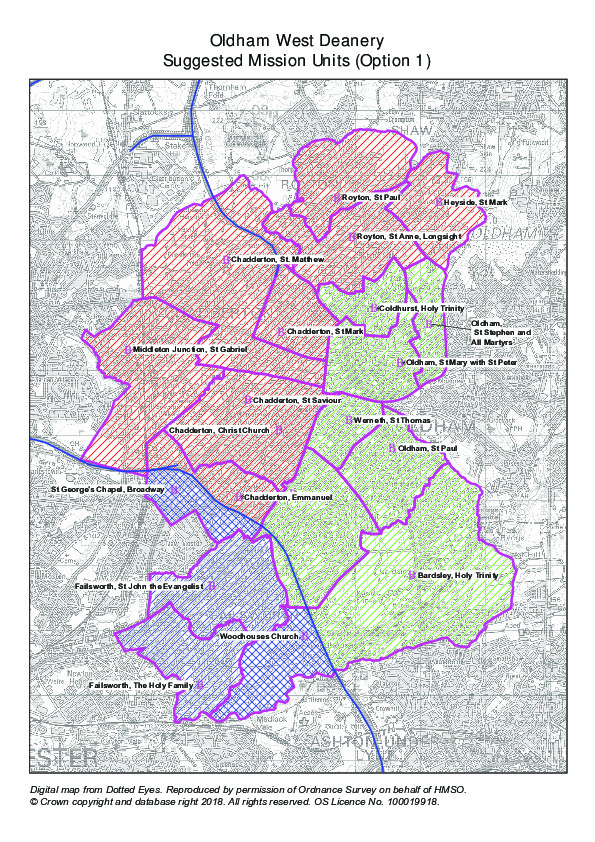
We are holding in tension two different options, until such time as (a) Deanery changes; and (b) a Diocese-wide view on Mission Units has taken place.
Clergy numbers for the proposal are on the rough basis of 0.5 clergy per church discussed at DMPC - and, at this point, symmetrical: 3 Mission Units in the Deanery: 3 stipendiary clergy posts in each Mission Unit.
Option 1
| Colour | Parishes / Churches (according to current benefices) |
Timescales | Training or Support needed | Included within Mission Action Plan? | Comments |
|---|---|---|---|---|---|
| BLUE |
Failsworth, Holy Family | . . . . . . . . . . to North Manchester Deanery . . . . . . . . . . | Only those parts of parishes INSIDE the M60 would go to North Manchester Deanery. The rest remains in Oldham West Deanery. |
||
| Bardsley, Woodhouses Church | |||||
| Failsworth, St John | |||||
| Chadderton, St. George | |||||
| GREEN 6.5 parishes 7 churches ?? 4.0 Stip. Clergy |
Bardsley, Holy Trinity Church | ||||
| Hollinwood, St Margaret | |||||
| Oldham, St Paul Werneth, St Thomas |
|||||
| Oldham, St Mary with St Peter | |||||
| Coldhurst, Holy Trinity Oldham, St Stephen & All Martyrs |
|||||
| RED 7.5 parishes 8 churches ?? 4.0 Stip. Clergy |
Middleton Junction, St Gabriel Chadderton, St Mark |
||||
| Royton, St Paul | |||||
| Chadderton, Christ Church | |||||
| Chadderton, St Matthew & St Luke | |||||
| Royton, St Anne Heyside, St Mark |
|||||
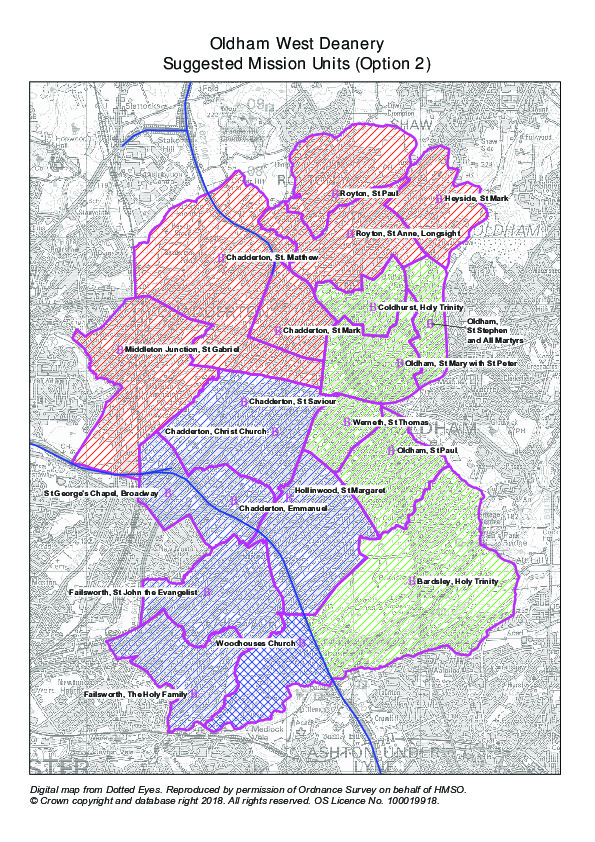
Option 2
| Colour | Parishes / Churches (according to current benefices) |
Timescales | Training or Support needed | Included within Mission Action Plan? | Comments |
|---|---|---|---|---|---|
| BLUE 5.5 parishes 7 churches ?? 3.0 Stip. Clergy |
Failsworth, Holy Family | ||||
| Bardsley, Woodhouses Church | |||||
| Failsworth, St John | |||||
| Hollinwood, St Margaret | |||||
| Chadderton, St George | |||||
| Chadderton, Christ Church | |||||
| GREEN 5.5 parishes 6 churches ?? 3.0 Stip. clergy |
Bardsley, Holy Trinity Church | ||||
| Oldham, St Paul Werneth, St Thomas |
|||||
| Oldham, St Mary with St Peter | |||||
| Coldhurst, Holy Trinity Oldham, St Stephen & All Martyrs |
|||||
| RED 6.5 parishes 6 churches ?? 3.0 Stip. Clergy |
Middleton Junction, St Gabriel Chadderton, St Mark |
||||
| Royton, St Paul | |||||
| Chadderton, St Matthew & St Luke | |||||
| Royton, St Anne Heyside, St Mark |
Appendices
The Diocesan Vision
"A worshipping, growing and transforming Christian presence at the heart of every community"
The Diocesan key mission objectives (goals) are:
- GROWING: growing new disciples in missionary church communities which are younger, more diverse, active and spiritually engaged
- NURTURING: increasing vocations, nurturing new and existing disciples, increasing financial giving
- SERVING: present for all, speaking and acting prophetically for justice, supporting pastorally especially the vulnerable, deprived and excluded
Five Marks of Mission
The Five Marks of Mission are:
- TELL: To proclaim the Good News of the Kingdom.
- TEACH: To teach, baptise and nurture new believers.
- TEND: To respond to human need by loving service.
- TRANSFORM: To transform unjust structures of society, to challenge violence of every kind and pursue peace and reconciliation.
- TREASURE: To strive to safeguard the integrity of creation, and sustain and renew the life of the earth.
The Five Guiding Principles
2014 Deanery Plan
You can look at the October 2014 Deanery Plan to see where we were at that point, in particular the options from page 32 onwards.